Visual answer · published 2026-09-26 · data captured 2026-08-07
Is my refrigerator water filter really certified?
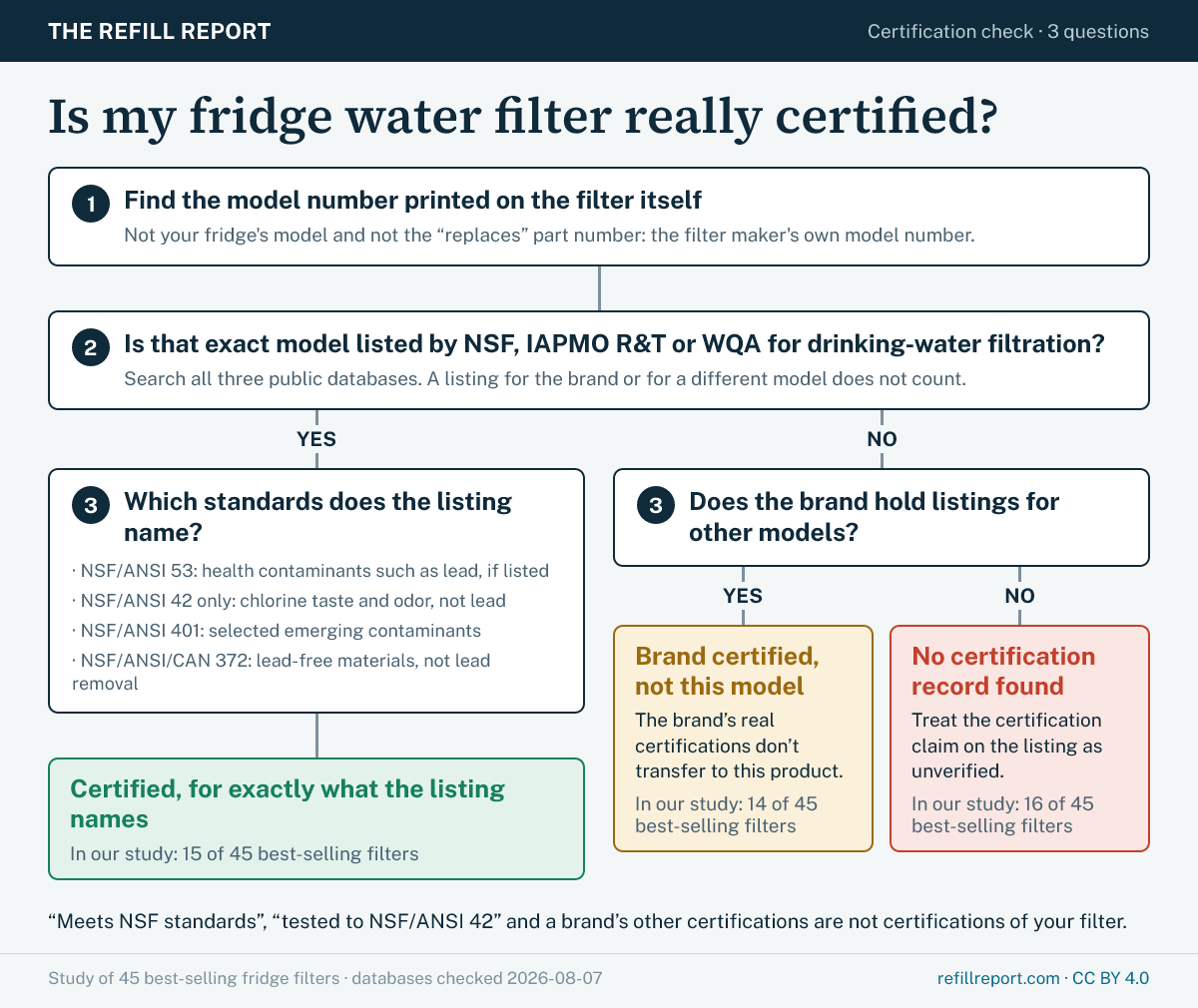
Your filter is certified only if its exact model number is listed by NSF, IAPMO R&T or WQA under a drinking-water filtration standard, and it is certified only for the standards that listing names. A certified brand, “meets NSF standards” or “tested to NSF/ANSI 42” does not count. When we ran this check on 45 best-selling fridge filters on 2026-08-07, 15 (33%) passed.
The check, step by step
- Find the model number printed on the filter itself. Not your fridge's model and not the “replaces” part number: the filter maker's own model number.
- Is that exact model listed by NSF, IAPMO R&T or WQA for drinking-water filtration? Search all three public databases. A listing for the brand or for a different model does not count. Our guide How to check whether a water filter is actually NSF certified walks through each database search.
- If the exact model is listed, read which standards the listing names. That is the limit of what the filter is certified to do:
- NSF/ANSI 53: health contaminants such as lead, if listed
- NSF/ANSI 42 only: chlorine taste and odor, not lead
- NSF/ANSI 401: selected emerging contaminants
- NSF/ANSI/CAN 372: lead-free materials, not lead removal
- If it is not listed, check whether the brand holds listings for other models. That decides which of the two remaining answers applies.
What each answer means
Certified, for exactly what the listing names
The exact model is in a certification database. It is certified for the standards on that listing and nothing more: a filter listed only under NSF/ANSI 42 is certified to reduce chlorine taste and odor, not lead. 15 of the 45 filters in our study got this answer.
Brand certified, not this model
The brand holds real certifications, but for other products, and they don’t transfer to this one. 14 of the 45 filters in our study got this answer.
No certification record found
No listing for the model or its brand turned up in the databases, or the search could not be completed. Treat the certification claim on the listing as unverified. In our study 16 of 45 filters landed here: 9 with no listing found and 7 we could not verify. Could not verify is not the same as uncertified; our study explains the difference for each filter.
“Meets NSF standards”, “tested to NSF/ANSI 42” and a brand’s other certifications are not certifications of your filter. Why the wording matters: Is “meets NSF standards” the same as NSF certified? Looking for a filter for a specific refrigerator? The fitment index shows every compatible filter we checked, with its answer.